Steam Machine Price in 2026: Scalpers, Shortages, and How to Know If the Deal You're Seeing Is Actually Fair
New gaming tech is exciting, but with AI driving up hardware demand, prices are volatile. Should you invest in that new GPU or Steam Machine, or hold out for a deal? We break down market trends and smart strategies to save.
Steam Machine Price in 2026: Scalpers, Shortages, and How to Know If the Deal You're Seeing Is Actually Fair
Valve's new living-room PC is one of the most anticipated hardware launches in years. It's also going to be a scalper's paradise. Here's how to protect yourself.
Last updated: April 2026 · Track Steam Machine prices and get scalper alerts on PriceWatch AI
The setup: a hyped launch into a broken supply chain
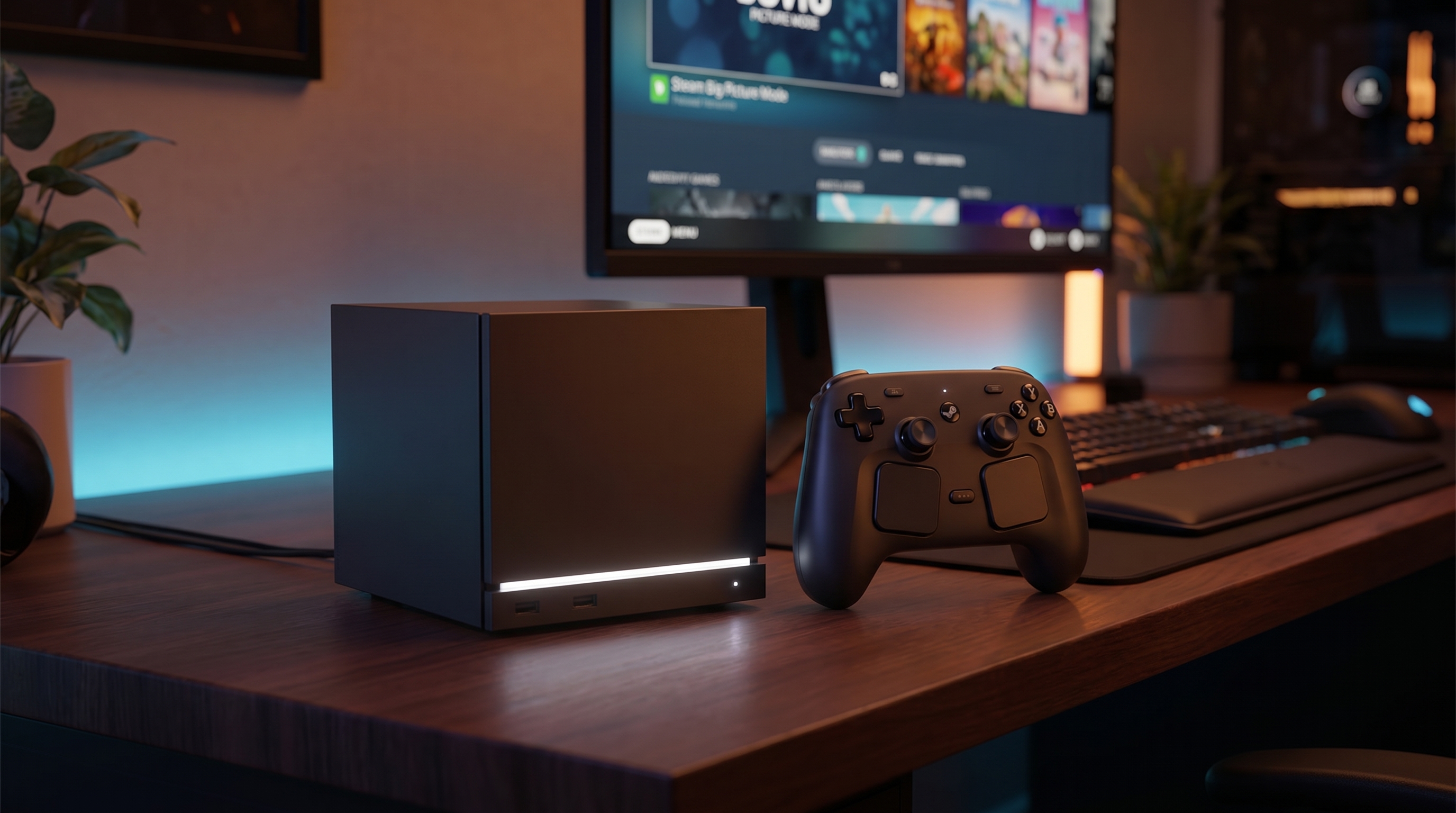
Valve's new Steam Machine is coming in 2026. It's a compact living-room PC, SteamOS-powered, with a custom AMD CPU and GPU — and it's already one of the most-discussed hardware releases in gaming communities. That combination of hype, delayed release date, and genuine component scarcity is a perfect storm for scalpers.
We've seen this play out with the PS5, RTX 30-series cards, and Steam Deck. Launch day stock disappears in minutes. eBay listings appear immediately at 2x retail. Reddit fills up with "is this a good deal?" posts. And frustrated buyers end up overpaying hundreds of pounds because they couldn't tell a fair price from an inflated one.
This time, the underlying supply problem is worse than any of those launches. And that means knowing the real Steam Machine price before you buy is more important than ever.
Why Steam Machine stock will be tight from day one
Valve has already publicly admitted it's struggling. In February 2026, the company said that rising costs and limited availability of RAM and storage had forced it to delay the launch and revisit pricing. This is not boilerplate PR — it's the same crisis hitting every PC maker right now:
- DRAM prices spiked over 80% in the first six weeks of 2026 alone
- AI datacenters are consuming ~20% of all DRAM production globally, leaving less for consumer hardware
- SK Hynix sold out its entire 2026 RAM production capacity to hyperscalers
- A standard 2TB gaming SSD that cost $173 in 2024 now sells for $649 as of April 2026
- Major PC vendors (Dell, HP, Lenovo, Acer, ASUS) have all warned of 15–20% price hikes
Valve wants to build a compelling product at a reasonable price. But the Steam Machine packs 16 GB DDR5, 8 GB GDDR6, and NVMe storage — all three of the components that are currently in shortage. If Valve can't manufacture enough units at launch, scalpers will fill the gap and charge whatever the market will bear.
What the Steam Machine should actually cost
There's no official retail price yet. But based on the hardware specs and analyst estimates, here's the realistic range:
| Scenario | Expected retail price (USD) | What it means for scalpers |
|---|---|---|
| Best case — Valve secured components early | $600–$650 | Scalpers list at $900–$1,000+ |
| Likely case — partial exposure to shortage | $750–$800 | Scalpers list at $1,100–$1,200+ |
| Worst case — full PC-tier pricing | $1,000+ | Scalpers list at $1,400+ and some buyers won't notice |
The problem is that without a publicly known retail price, many buyers simply won't know what's fair. If you see a Steam Machine on eBay or StockX for £850 the week after launch, is that a reasonable premium or highway robbery? Without price history to anchor against, it's genuinely hard to tell.
This is exactly the gap PriceWatch AI fills. Once retail prices are confirmed, we track them across every major retailer in real time, so you can see immediately whether a listing is near retail, inflated, or a genuine deal.
The scalper playbook — and how to beat it
Scalpers are not random opportunists anymore. They use bots to buy entire launch allocations in seconds, cross-list across eBay, StockX, Facebook Marketplace, and Discord servers simultaneously, and price items just high enough that impatient buyers justify it as "only a bit over retail." The Steam Machine will attract all of this.
How you beat it:
- Know the retail price before you shop secondhand. If Valve announces $699, then $850 on eBay is a 21% markup. That's your number to beat before you even consider a scalper listing.
- Wait for price history to build. In the first 72 hours after launch, secondhand prices are at their peak. Within 2–4 weeks, they typically drop 15–20% as impatient scalpers undercut each other. PriceWatch AI shows you this price history curve so you can time your purchase intelligently.
- Set a target, not a deadline. The biggest mistake buyers make is treating launch day as a hard deadline. Most people who couldn't get a PS5 at launch paid $150–$200 over retail needlessly. Set a target price, set an alert, and wait.
- Spot fake "deals". A listing marked down from an inflated anchor price is not a deal. Price trackers show you what the item actually sold for historically — not what a seller claims it was worth.
Will Steam Machine prices drop? And when?
Yes — but probably not as fast as you'd hope. With the RAM shortage expected to persist through 2026 and into 2027, there are three realistic scenarios:
- Price holds steady for 6–12 months. Valve can't offer discounts on hardware it can barely produce at cost.
- Price quietly increases. Framework Desktop went from $1,099 to $1,139 in January 2026 mid-cycle, purely due to RAM costs. Valve could do the same.
- Meaningful drop in 2027+ once new Micron fabs come online and component costs normalize. This is the real price drop — but it's a year or more away.
The practical implication: there is no "safe" time to buy carelessly. Whether you're buying at retail or secondhand, knowing the current going rate is the only edge you have. PriceWatch AI's price analysis tells you in seconds whether a deal is fair based on real transaction data, not seller-stated RRP.
Quick specs recap — what you're actually buying
| Component | Spec |
|---|---|
| CPU | Custom AMD Zen 4, 6 cores / 12 threads, up to 4.8 GHz |
| GPU | Custom AMD RDNA 3, 28 CUs, 8 GB GDDR6 (roughly RX 7600 class) |
| RAM | 16 GB DDR5 SODIMM (user-upgradeable) |
| Storage | 512 GB or 2 TB NVMe + microSD expansion |
| Size | ~156 × 152 × 162 mm cube |
| Target performance | 1080p @ 30 fps minimum for Verified titles |
| OS | SteamOS 3.x (Linux + Proton) |
It's a solid couch gaming PC. It is not a 1440p powerhouse. Know what you're paying for before a scalper convinces you it's worth $1,200.
Bottom line
The Steam Machine launch is going to be chaotic. Limited stock, no confirmed retail price, an active scalper market, and a hardware cost environment that makes every listing look vaguely plausible — it's a bad combination for buyers acting on impulse.
The one advantage you can give yourself is information. Know the retail price the moment it's announced. Track where secondhand prices actually land. Set a target and let an alert do the watching for you.
That's what PriceWatch AI is built for.